





Accueil » Procurement Software Features » Procurement Catalogs
Procurement Catalogs
Access your products and services, all centralized in one place.
- One catalog for your items
- One for your products
- One for your services
- All available to your entire team

The current challenges of procurement catalogs
Without a dedicated tool, managing items and services quickly becomes unmanageable.
Here are the obstacles most companies face:
1) Scattered and outdated information
Teams struggle to find the right items, juggling spreadsheets, internal files, and email attachments. Duplicates multiply and data becomes obsolete. The result: inconsistent orders and a total lack of visibility.
2) Lack of control over prices and suppliers
Incorrect pricing, outdated terms, undetected discrepancies… Without a dynamic catalog, negotiated prices aren’t enforced and spending spirals out of control.
3) Over-reliance on the procurement team
Every request requires validation, verification, or information. Procurement teams waste considerable time responding to internal queries, slowing down the entire process.
4) No visibility into recurring services
Without a single source of truth, each department orders differently. This leads to price variations, multiple suppliers for the same service, and a complete lack of consistency.
5) Standardization is nearly impossible
Maintenance, general services, subscriptions: without a structured catalog, it’s difficult to track which services are actually used, how much they cost, and how often.
Weproc designed a complete solution—including catalog management—to solve these exact challenges.
How does Weproc solve these problems?
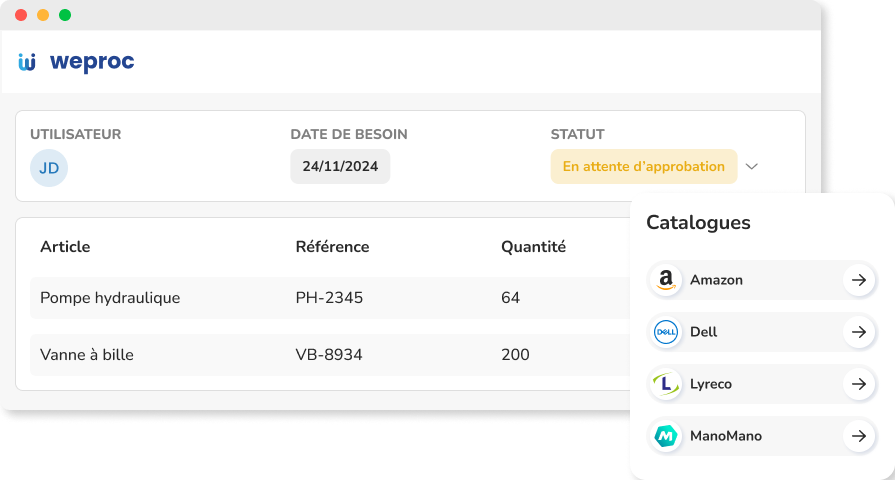
Weproc's Smart Catalog: Your single source of truth for procurement
Weproc centralizes your items, products, and services in a structured space that’s easy to maintain and accessible to your entire team. Each entry contains essential details: negotiated prices, last order date, associated supplier, spend categories, special conditions, and a complete history.
Thanks to real-time updates and controlled access rights, your teams can order autonomously, without errors, and in full compliance with your internal policies.

Spend Categories & Sub-categories
Organize your catalog with your procurement categories. Ordering becomes simpler and faster, and your analytics become more insightful.
Price Management & History
Each item displays its current price, price evolution, last order details, and applied conditions. You ensure perfect traceability.
The Core of the Catalog: Key Features
Product Catalog
Structure all physical items purchased by your organization: IT hardware, consumables, supplies, equipment, spare parts…
Each product sheet is standardized, enriched, and linked to a negotiated price, ensuring consistent and compliant ordering.
Service Catalog
Organize your recurring services: cleaning, maintenance, general services, IT support, technical interventions.
Clearly define the terms, frequencies, and conditions to simplify tracking and automate approvals.
Connected Supplier Catalog
Your suppliers can update their prices, items, services, and conditions directly from their dedicated portal.
Your catalogs stay consistent, reliable, and automatically synchronized.

Spend Analysis and Usage Tracking
With consolidated data from your catalogs, you gain access to strategic KPIs: usage frequency, average prices, most-used suppliers, and highest-cost categories.
You can identify opportunities for optimization, renegotiate with solid data, and manage your budgets in real time.

Real-World Use Cases
A solution for every type of organization.
All your locations access the same products, same conditions, and same suppliers. You harmonize your purchasing and reduce discrepancies.
Retail or Franchise Networks
Individual stores or locations maintain their autonomy while ordering in compliance with centrally negotiated agreements.
Standardize your practices, reduce off-contract spend, and unify your item database across the entire organization.
Indirect Spend
IT, general services, subscriptions, one-off services: finally get control over scattered and hard-to-track expenses.

How do catalogs work?
1. Import your items
Import your products, services, and items. Weproc categorizes them automatically.
2. Connect your suppliers
They update their prices and services directly in your catalog.
3. Share catalogs with your teams
They only order approved items, reducing errors and discrepancies.
Weproc is the only solution that brings together all the essential information for your procurement process.
Before Weproc
Multiple, inconsistent item references
Outdated and uncontrolled prices
Long and uncertain ordering process
Constant dependency on the procurement team
No consolidated view of services
With Weproc
Structured and harmonized catalog
Single item references, up-to-date prices
Simple and seamless process
Fast, compliant ordering
Clear visibility into recurring purchases
The benefits for your company:
✔ Significant time savings: No more asking for prices, availability, or the approved supplier: everything is visible and up-to-date in one click.
✔ Total purchasing standardization: Eliminate rogue items, unapproved suppliers, and off-process purchases.
✔ Better budget management: With structured data, you can analyze your spend accurately and anticipate future needs.
✔ Secure supplier relationships: Information is centralized, terms are respected, and data is aligned.
Complementary Modules
Weproc is modular, allowing you to cover every step at your own pace: Purchase Requisitions, Sourcing, Contracts, Invoices & Payments, Budgets, Spend Categories, Inventory… Build your Source-to-Pay journey without the complexity.

Supplier Management

Contract Management

Category Management
Easily create and manage your spend categories. Get a complete overview and make strategic decisions.
FAQ – Catalog Management Feature
To structure a product catalog effectively, it’s important to classify items into different spend categories, based on their nature, use, or business area.
This organization makes it easier to search, compare, and select products, as well as manage supplier contracts. It’s also essential to keep information up-to-date, including prices, descriptions, and delivery terms, to optimize procurement and budget management.
A centralized product catalog offers several advantages, especially for multi-site companies.
It ensures consistency and uniformity of information across different locations, facilitates communication and coordination between procurement teams, and thus optimizes supplier management. Additionally, a central catalog makes it easier to analyze and track purchasing performance, thanks to cost allocation and its consolidated data.
To integrate services into a procurement catalog, it’s important to create dedicated categories to distinguish them from physical items. These categories can group services by type (maintenance, training, support, etc.) or by area of expertise (IT, logistics, marketing, etc.).
Services must be clearly defined, with detailed descriptions and specific terms (duration, pricing, implementation details), to facilitate the management of purchases and supplier contracts.
To keep a product catalog up-to-date, it’s essential to implement a suitable workflow, including validation and information updates by procurement managers and suppliers. It’s also important to conduct regular audits to check data consistency, price changes, and product availability. Using analytics tools helps identify opportunities for improvement, such as streamlining product lines, negotiating new contracts, or creating synergies between locations.
To select suppliers for a product catalog, several criteria should be considered, such as the quality and reliability of products, pricing, delivery times, payment terms, and compliance with certifications and standards.
Want to learn more about catalog management?
Discover our weekly articles, webinars, and free templates to improve your catalog management!

Procurement Digitalization: Accelerate Operational Excellence
Procurement digitalization is no longer just an option, but a necessity to optimize processes, reduce costs, and achieve sustainable operational excellence.

Spend Control and Procurement Management: Keys to Business Performance and Resilience
The ability to adapt, innovate, and above all, control operations has become a determining factor for survival and success. At the heart of this lies an essential strategy: Spend Management.

Optimizing Your Supplier Database: The Key to Procurement & Finance Operational Excellence
This isn’t a luxury, but a strategic necessity. It allows you to transform daily challenges into opportunities for continuous improvement and value creation.