





Accueil » Procurement Software Features » Cost Allocation & Spend Analysis
Cost Allocation
Get Granular Spend Analysis and Reliably Manage Your Cost Centers.
- operational dashboard
- Structures your required actions
- Detailed spend analysis by cost center

Why Cost Allocation Matters
…………………………………………………………………………………………
Manque de fiabilité dans la ventilation des dépenses
Manque de fiabilité dans la ventilation des dépenses
Difficulté à suivre les coûts réels par activité
Difficulté à suivre les coûts réels par activité
Analyses chronophages et non automatisées
Analyses chronophages et non automatisées
How Weproc Transforms Your Spend Analysis

Full Control Over Your Cost Allocation Structure
You define your allocation rules (by department, project, location, or spend category) — Weproc handles the rest.
→ Eliminate manual guesswork and ensure consistent data for everyone.

Automated, Error-Free Cost Allocation
Every purchase order is assigned to the correct cost centers instantly. No more manual rework.
Your pre-accounting is accurate before invoices even arrive.

Clear, Actionable Financial Insights
Spot overspending, variances, and trends. Pinpoint which cost centers consume the most resources. Summary dashboards simplify account reconciliation and internal audits.

Core Cost Allocation Features
Allocate spend to one or multiple cost centers
Use multi-tagging to split a single purchase across several cost centers based on your custom rules.
Track cost center commitments in real time
Every purchase instantly updates your committed, accrued, and actual spend.
Advanced KPIs for Finance Leaders
Break down spend by time period, purchase type, user, or project.
All data is consolidated automatically.
Global visibility with drill-down detail
Go from a high-level dashboard to a specific line item in a single click.
How Does Weproc Allocate Your Spend?
1. Define your allocation dimensions (cost centers, projects, categories, activities, etc.).
2. Assign automatic allocation rules.
3. Your teams create requisitions: allocation happens instantly.
4. Internal approvals ensure allocation compliance.
5. Spend data feeds your analytical dashboards.
6. Export clean, actionable data for your accounting system.
See concrete use cases for procurement software
Accounting teams get standardized allocation from the moment a purchase is made, eliminating manual rework and ensuring consistent exports that match the company’s chart of accounts. Financial controllers can more easily analyze variances, track cost center performance, and build reliable forecasts with continuously updated commitment data. Finance directors get a consolidated view of spend by activity, project, or location, simplifying the preparation of pre-accounting entries. Finally, multi-site organizations can standardize their allocation rules and instantly compare performance across sites, stores, agencies, or subsidiaries for consistent, controlled management.


Instant Visibility Into Your Cost Centers
Weproc saves you time with smart, automated cost allocation for all your spend.
Track where every dollar is spent
Poor allocation can hide budget overruns. With Weproc, every purchase is tied to a cost center from the start. –> No more rogue spend or allocation gaps.
Dynamic Analysis
Drill down into each cost center’s share of total spend, spot anomalies, and identify opportunities for optimization.
Continuously Updated Data
Your teams always have an accurate, up-to-date view of their performance, ready for instant use in your pre-accounting workflow.
Implement Reliable Cost Tracking
Automated or Custom Allocation
Weproc applies your predefined rules based on department, project, location, or spend category.
Stronger Internal Controls
Eliminate ‘orphan’ and non-compliant spend. Every line item is allocated correctly, catching errors before they ever hit your books.
A Richer Overall View
Committed, actual, allocated: get the complete financial picture.
Access all your company’s commitments and target high-potential areas for performance improvement.


Ensure Full Data Transparency
Easy-to-Use Analytics
Cross-reference data across multiple periods and compare performance between business units.
Streamlined Accounting
Exportable allocation data simplifies pre-accounting and eliminates manual rework.
Better-Informed Decisions
Leadership can identify the most costly or profitable activities and make strategic decisions based on reliable data.
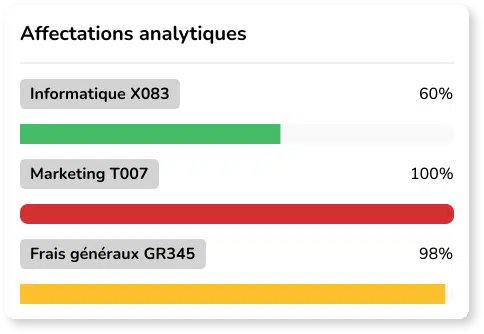
Intelligent Spend Analysis
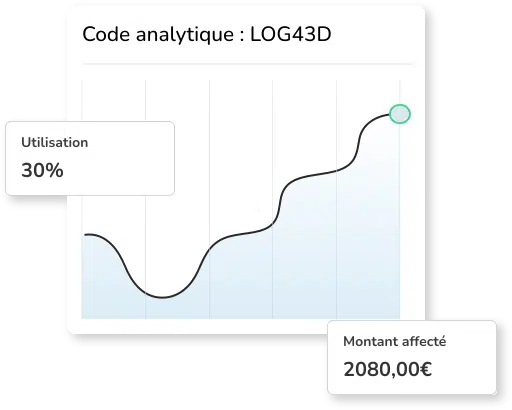
Assign one or more allocation codes to every purchase to analyze spend against your cost centers.
With dynamic, analysis-ready dashboards, your e-procurement software breaks down spend by cost center, project, or category. Instantly detect trends and anomalies like unusual variations, spending spikes, or significant variances. This real-time data empowers you to anticipate issues, take action, and streamline your pre-accounting.
By providing a structured and reliable analytical foundation, Weproc directly supports your financial forecasts and improves budget management across the company, helping you prepare accurate pre-accounting entries.
2 out of 3 companies report non-compliant spend that violates internal purchasing policies.
Related Modules
Weproc is modular, covering every step of your process: Purchase Requisitions, Sourcing, Contracts, Invoices & Payments, Spend Categories, Inventory, and more. Build your ideal Source-to-Pay workflow at your own pace, without the complexity.

Budget Management

Catalogs
Simplify ordering by centralizing all your products and services in one catalog.

Spend Category Management
Optimize project and category management by tracking their progress in real time with Weproc.
FAQ – Cost Allocation in Weproc Procurement Software
Cost allocation is a method of assigning procurement costs to different activities, departments, or projects within a company. It provides a detailed and precise view of spend, which facilitates performance analysis, budget control, and strategic decision-making.
By using cost allocation, companies can identify cost optimization opportunities and improve the effectiveness of their procurement management.
To implement effective cost allocation, it’s important to define relevant allocation criteria based on the company’s goals and specifics. This can include allocation by department, project, spend category, or cost center.
It is also crucial to establish clear and consistent procedures for cost assignment, as well as suitable tracking and reporting tools to ensure regular monitoring and in-depth analysis of spend on your projects.
In a multi-site context, it is essential to standardize cost allocation criteria and procedures to ensure a comprehensive and coherent view of spend.
This can be achieved by implementing a centralized procurement software, which allows for easy sharing of information and best practices between different locations, and by defining common rules for cost allocation that take into account both local and global specifics.
Weproc notably allows for the integration of custom approval workflows that facilitate collaboration between teams.
The main challenges of cost allocation include defining relevant allocation criteria, establishing clear and consistent procedures for cost assignment, and implementing tracking and reporting tools tailored to your files.
It is also important to ensure the reliability and completeness of the data used for cost allocation and to make sure that stakeholders understand and support the methods and objectives of the system.
Cost allocation can be used to better understand the costs associated with each supplier and to identify opportunities for improving supplier relationships and their associated contracts.
By analyzing spend per supplier and comparing it against performance criteria and company objectives, it is possible to evaluate the effectiveness of your partnerships.
Want to Learn More About Spend Management?
Discover our weekly articles, webinars, and free templates to improve your spend management!

Procurement Software Evaluation Template (Excel & Google Sheets)
This Excel/Google Sheets template helps you make a rigorous selection of a procurement software solution by evaluating functional, technical, budgetary, and organizational criteria.

The Procurement Function: A Strategic Lever for Operational and Financial Excellence
Its evolution from simple order placement to defining global sourcing policies is an irreversible trend affecting organizations of all sizes, from SMBs to large international corporations.

Analyzing Your Supplier Purchasing Cycle: Strategies and Tools
At the heart of this process is the supplier purchasing cycle, a fundamental workflow also known as Procure-to-Pay (P2P).