





Accueil » Procurement Software Features » Departmental Spend Management
Departmental Spend Management
Structure and Analyze Spend Across All Your Departments
- Centralize internal requests
- Streamline collaboration
- Organize purchasing workflows
- Track departmental spending in real time

The Challenges of Managing Departmental Spend
…………………………………………………………………………………………
Manque de visibilité sur les besoins internes
Manque de visibilité sur les besoins internes
Dépenses difficilement maîtrisées
Dépenses difficilement maîtrisées
Processus non harmonisés entre les services
Processus non harmonisés entre les services
How Weproc helps:

Clear, Unified Organization
Every department manages its purchasing in a dedicated workspace. Managers get a single, centralized view of all activity.

Faster Decisions with Reliable Data
Spend, budgets, and cost allocations by department are updated automatically. Leadership gains visibility and control.

Better Internal Coordination
Teams collaborate in one shared tool, streamlining communication, reducing friction, and improving overall performance.

The Core of Departmental Management
Centralize and structure each department’s needs
Every request is correctly assigned to the right department, ensuring clear management of all internal purchasing: IT, HR, marketing, facilities, production, and more.
See spend allocation in real time
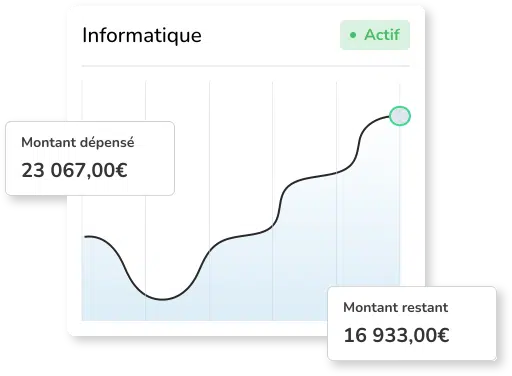
Committed, pre-committed, and actual spend are updated automatically. Instantly identify which departments have the highest spend and which are at risk of budget overruns.
Empower teams while maintaining control
Managers can handle their department’s needs, track KPIs, and supervise their teams while adhering to company-wide policies set by leadership.
Analyze internal performance department by department
Weproc highlights variances, trends, and opportunities for improvement: better negotiations, standardization, and cost optimization.
How does departmental management work in Weproc?
1. Create or import your departments (HR, IT, Marketing, Finance, etc.).
2. Assign team members, roles, and permissions.
3. Your departments submit their requests directly in Weproc.
4. The correct approval workflows and budgets are applied automatically.
5. Spend is grouped by department, analyzed, and consolidated.
6. You manage everything from a single dashboard.
Real-world use cases for procurement software?
Every department gets clear, structured oversight of its procurement. The IT department can manage hardware and software requests, ensure compliance, track licenses, and allocate costs per user. HR can supervise spending on training, onboarding, and employee equipment, with budget tracking for each program. Marketing and communications can control their campaigns, recurring purchases, and supplier monitoring. Facilities management can centralize supplies, maintenance, equipment fleets, and related contracts. Finally, the operations department can track field needs and technical purchases, gaining a consolidated view to better manage business activity.
See our page on different industries.


Spend Analysis by Department
A clear, real-time view of internal costs
Weproc automatically updates every expense and assigns it to the correct department. You can identify the biggest cost centers, track trends, and spot potential overspending.
Ready-to-use breakdown analyses
- by department
- by category
- by period
- by site or project
All data is actionable in one click.
Dedicated Workflows for Each Department
Configure custom approval workflows based on:
- spend type,
- financial thresholds,
- requesting department,
- internal policies.
Approvals become simple, fast, and consistent across the entire company.


Enforce Internal Policies
Standardize your internal practices
Use a single solution to manage spend across all departments. You ensure the consistent application of internal rules.
Complete traceability
Every request, approval, or action is time-stamped, logged, and clearly attributed.

Departmental Spend Management
Every purchase order instantly updates:
- spend,
- commitments,
- breakdown analyses,
- budget availability.
No more shadow spreadsheets and manual updates!

Weproc is the only platform that centralizes procurement for all your departments!
Complementary Modules
Weproc is modular, allowing you to cover every step of the process: Purchase Requisitions, Sourcing, Contracts, Invoices & Payments, Spend Categories, Inventory… Build your Source-to-Pay journey at your own pace, without the complexity.

Contract Management
Streamline your supplier contract management by easily tracking and sharing key information.

Catalogs
Simplify order management by grouping all your products and services into one catalog.

Category Management
Optimize your spend management by simplifying the creation and management of your procurement categories.
FAQ - Departmental Management in Procurement Software
Have questions? We have answers!
To structure and analyze procurement by department, it’s important to implement a suitable tracking and reporting process.
This involves categorizing spend by department, centralizing information in a procurement management system, and tracking the budgets allocated to each department.
Using analytical tools helps identify trends and optimization opportunities, facilitating decision-making and resource allocation.
To centralize and coordinate the purchasing needs of all company departments, it is essential to establish seamless communication and efficient workflows. This can be achieved by using collaborative tools, defining common procedures, and creating inter-departmental working groups. By centralizing purchase requisitions and structuring the required actions, it’s possible to increase efficiency and better meet the needs of each department.
To effectively track purchase requisitions in a multi-department context, it is important to adopt a procurement management system like Weproc that centralizes information and ensures request traceability.
Approval steps must be adapted to the specifics of each department, while ensuring effective coordination between the different stakeholders. Finally, performance indicators tailored to each department allow for monitoring procurement progress and continuously optimizing processes.
To optimize procurement management in a multi-department context, several best practices can be implemented.
It is essential to clearly define the needs and objectives of each department, promote collaboration and information sharing between departments, and foster a culture of continuous improvement. Implementing a centralized procurement management system also allows for tracking and analyzing each department’s spend, making it easier to identify optimization opportunities.
In a multi-department and/or multi-site context, it is important to implement scalable processes and tools.
This involves favoring modular and customizable solutions like Weproc, which can adapt to the specifics of each project and each case within the company. Furthermore, seamless communication and effective coordination mechanisms help to better anticipate market changes and react quickly to new demands from your suppliers.
Want to learn more about this feature?
Discover our weekly articles, webinars, and free templates to improve your departmental management!

Quality Audits: Optimizing Procurement and Finance for Operational Excellence
Far from being a mere formality, a quality audit is a proactive step that provides a clear, unbiased view of your systems’ performance.

Make or Buy: The Essential Strategy for Optimized Procurement and Finance
This theory, while sometimes seen as a purely rhetorical dilemma, becomes a full-fledged business strategy when an investment or purchasing decision impacts the organization’s finances and future.

Strategic Procurement Policy: A Lever for Operational and Digital Excellence
This article aims to guide you step-by-step in developing and deploying a strategic procurement policy, with a strong focus on digitalization